The Intelligence Buildout
An interactive field guide to the physical infrastructure behind AI, combining a 3D bookshelf, seven volumes, a dependency Atlas, twelve system guides, and an equipment and power simulator.

Project at a glance
| Role | Product strategy, research, editorial design, interactive visualization, and frontend engineering |
| Product | A published field guide to the physical infrastructure behind artificial intelligence |
| Scope | Seven volumes, 200 pages, twelve system guides, a dependency Atlas, a capacity simulator, and a source ledger |
| Core stack | Next.js, React, TypeScript, Three.js, React Three Fiber, Motion, Zustand, and Zod |
| Status | Live at intelligencebuildout.com |
From matter to intelligence
AI begins long before a prompt reaches a model. It depends on purified materials, precisely manufactured chips, memory, racks, networks, electricity, cooling, capital, and permission to build.
I built The Intelligence Buildout to make that physical chain understandable. The deployed edition brings together an interactive library, a visual reference system, and practical exploration tools. Readers can follow the story from beginning to end, investigate a dependency, or test how equipment choices change a deployment's power requirements.
The central product challenge was connecting a substantial body of research to an interface people would want to explore. The result pairs the familiarity of a bookshelf with the depth of a technical field guide.
What I built
A seven-volume interactive library
The homepage opens onto a three-dimensional shelf. Each volume has its own cover, material treatment, and place in the sequence: Matter, Precision, Package, Machine, Fabric, Plant, and Permission.
Selecting a book moves from the shelf to a volume introduction, then into the reader. The edition spans 28 chapters, 100 spreads, and 200 pages, supported by charts, documentary imagery, tables, and citations.
Book mode presents paired pages with warm paper surfaces and editorial typography. Focus mode gives the same material a continuous reading layout. Chapter navigation, adjustable type, saved progress, and addressable spreads make the experience useful beyond a first visit.
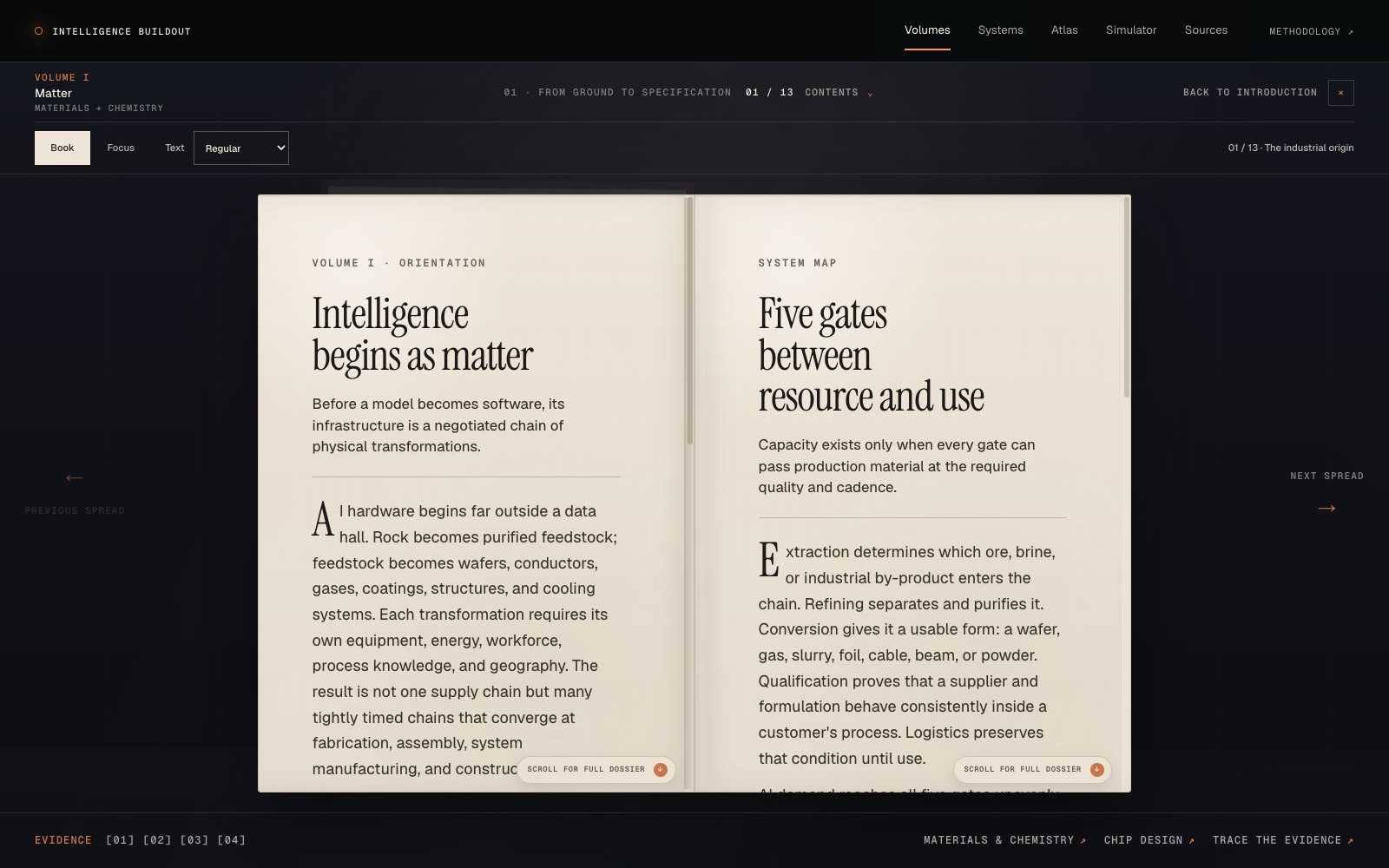 The Matter volume in Book mode, with paired editorial pages, reading controls, chapter navigation, and an evidence bar.
A dependency Atlas
The Atlas turns the buildout into an explorable operating chain. It maps 89 nodes and 121 relationships across twelve stages, from demand and capital through materials, fabrication, compute, power, policy, and communities.
Readers can search the chain, filter by stage, region, or analytical lens, and open a node or relationship to inspect its evidence. Guided investigations provide entry points into questions such as how memory becomes a machine or how power reaches a campus.
The visual map and its synchronized directory expose the same records. Shareable view state, mobile pan and zoom, and a text alternative keep the investigation usable across different devices and ways of navigating.
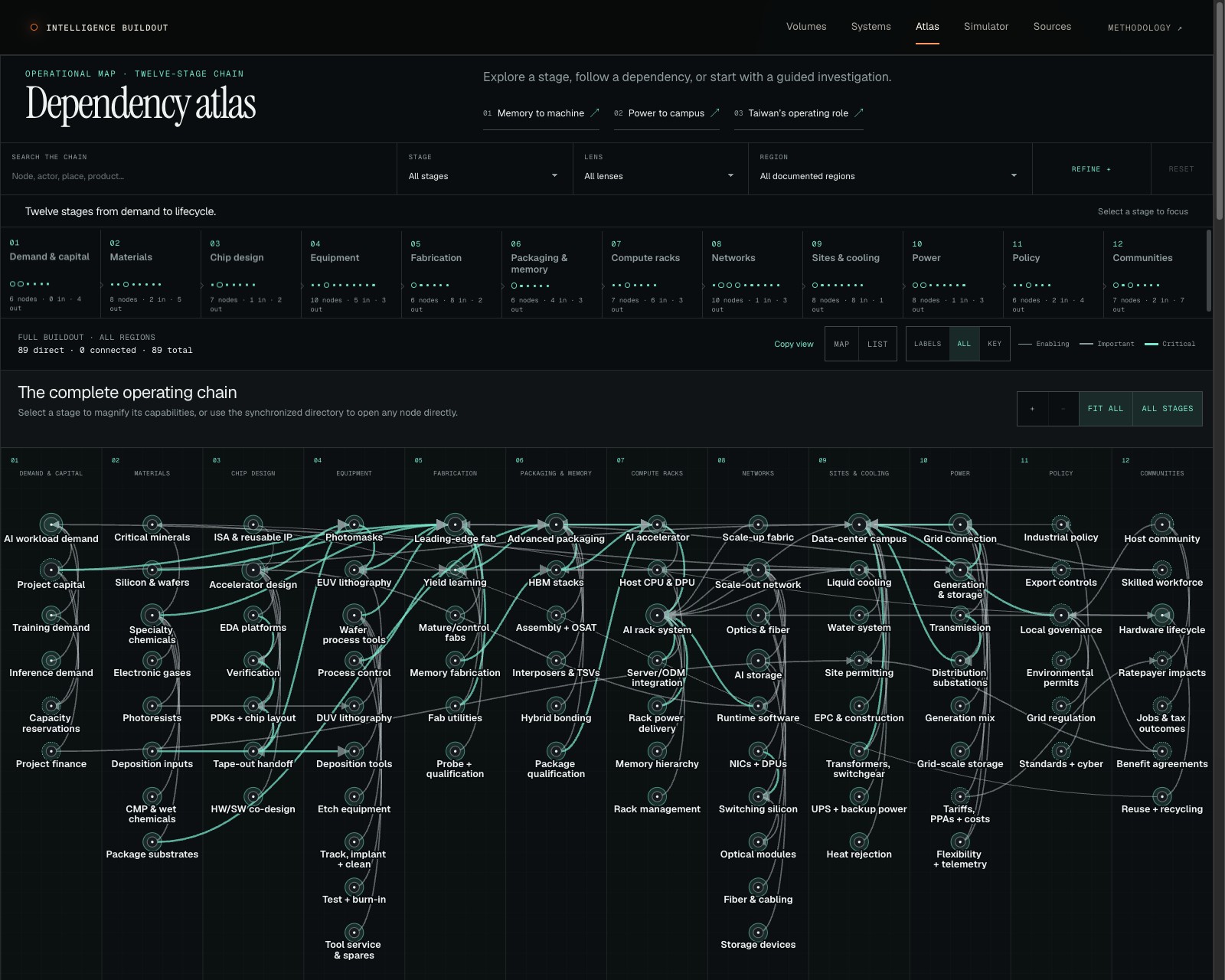 The Dependency Atlas connects the twelve stages of the physical AI buildout, with search, filters, guided investigations, and a synchronized directory.
Twelve system guides
The Systems reference gives each part of the chain a dedicated explanation. A reader can move from chip design to lithography, from packaging to rack integration, or from campus construction to the grid.
Each guide connects its explanation to selectable diagrams, key measures, documented dependencies, organizations, and supporting evidence. Links back to the Volumes and Atlas make those surfaces part of one research experience.
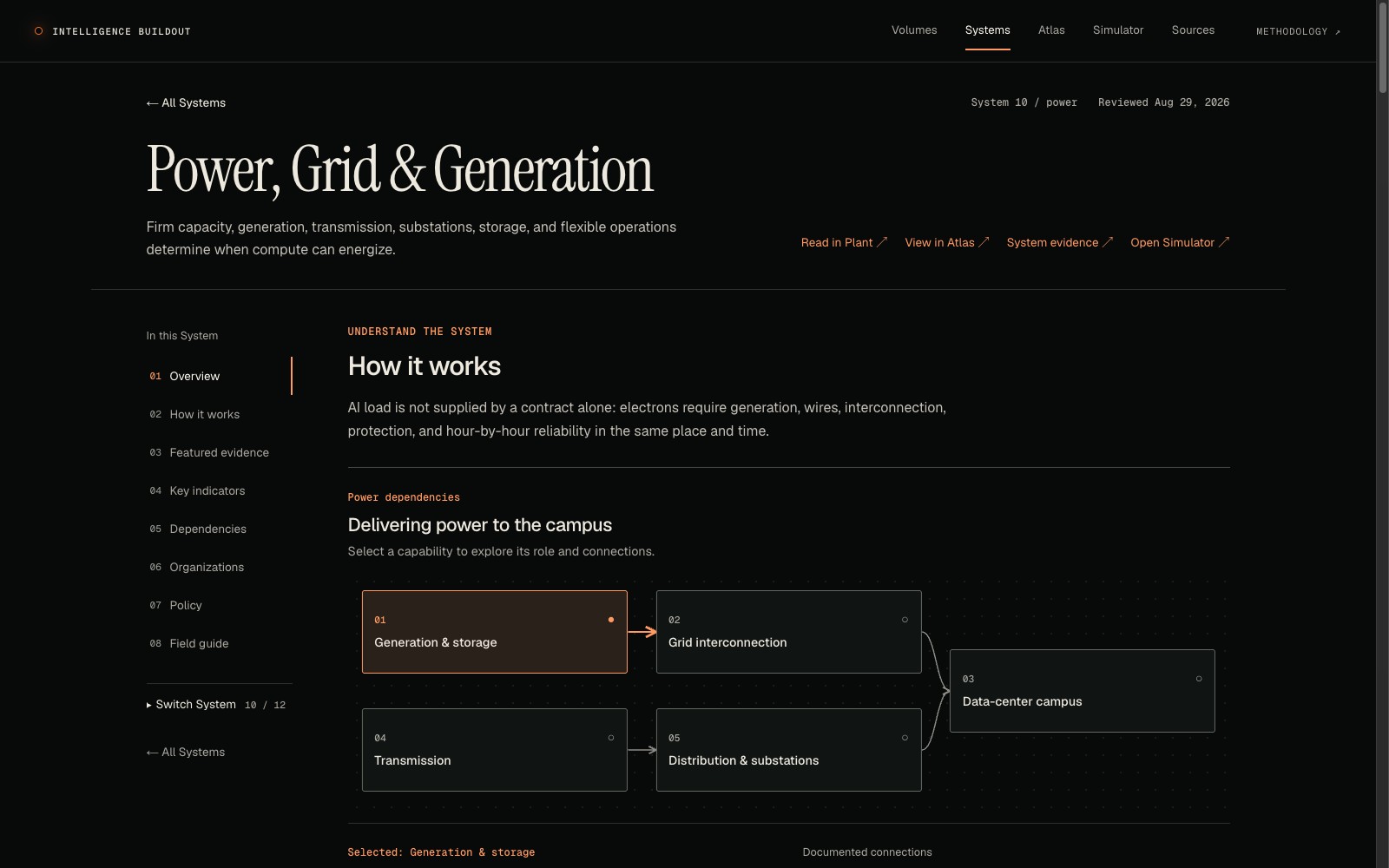 The Power, Grid & Generation guide uses a selectable dependency diagram to explain how generation, transmission, substations, and interconnection serve a campus.
An equipment and power simulator
The Simulator offers two starting points: a planned equipment deployment or an available power budget. Readers can adjust equipment and operating assumptions, inspect modeled capacity and energy requirements, compare scenarios, and share a configuration by URL.
The calculation model distinguishes server and rack units, reference facility capacity, average power, and annual energy. Optional site-water assumptions and an inspectable calculation ledger keep the meaning of each result visible. It is a bounded planning tool with explicit exclusions and assumptions.
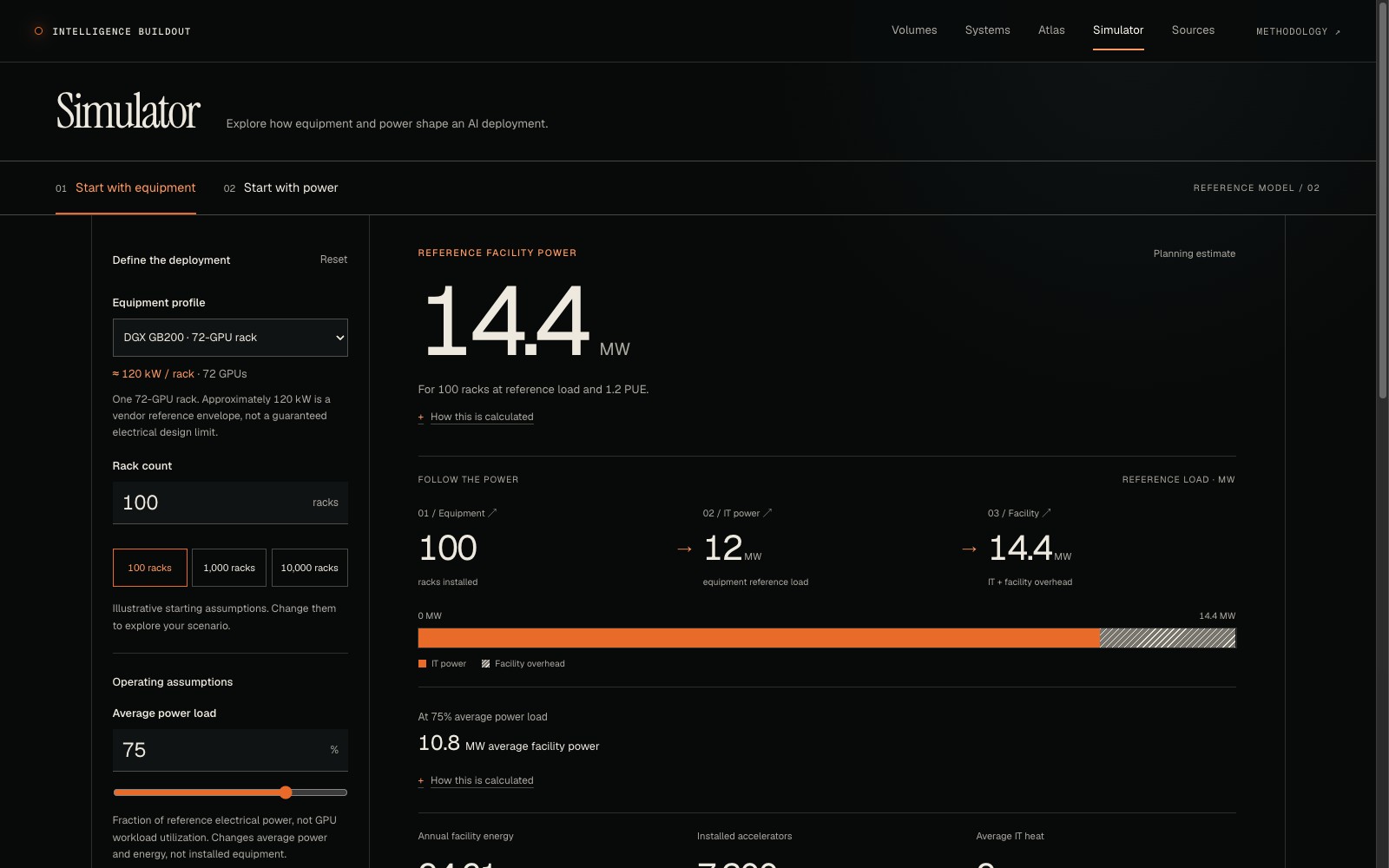 The Simulator starts with equipment and shows reference facility power, the flow from racks to megawatts, and adjustable operating assumptions.
Evidence throughout the experience
The edition's structured catalog contains 336 claims and 193 sources. The Sources ledger supports search and filtering, while citations connect the reading pages, diagrams, and Atlas dossiers to their supporting records.
Claims retain their classification, scope, relevant dates, confidence, and review information. Facts, estimates, projections, and stakeholder positions remain distinguishable. Those distinctions matter when a historical forecast, a measured result, and an announced project appear in the same explanation.
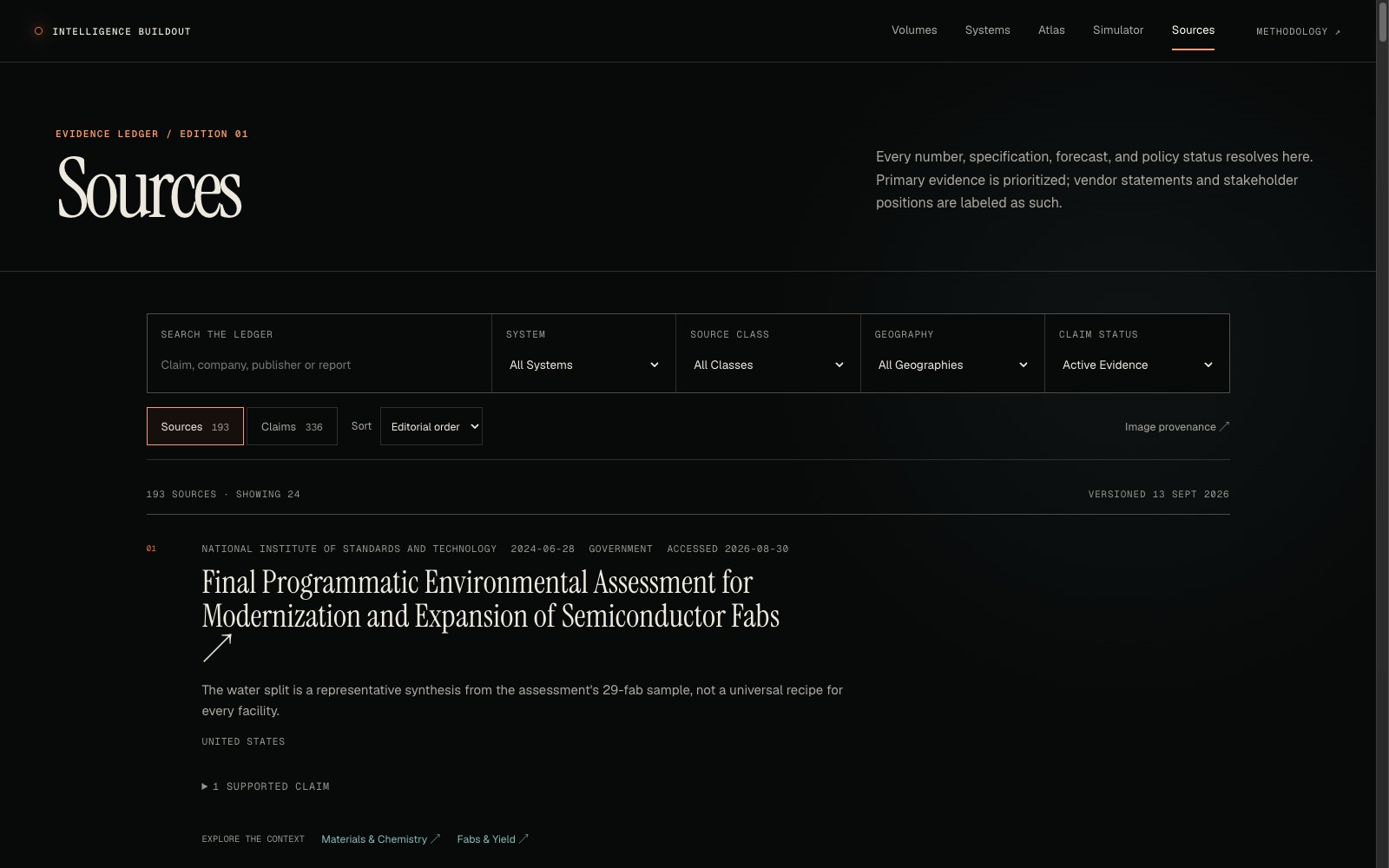 The Sources ledger makes the edition's evidence searchable and connects source records to the claims they support.
Design and engineering
Give the research a physical form
I built the reading experience around the relationship between shelf, volume, chapter, and spread. Dark reference surfaces, warm paper, large serif headings, and precise diagram labels give each mode a clear purpose while keeping the product visually connected.
The shelf integrates an adapted MIT-licensed ThreeUI bookshelf with local textures and the application's Three.js runtime. React Three Fiber supports the scene, while React and Motion coordinate the surrounding interface. The transition into reading carries the selected volume into a functional editorial workspace.
Publish a validated content edition
The current application uses a prerendered Next.js architecture with version-controlled TypeScript content. Zod schemas and content validators check references, claim provenance, measurement units, review deadlines, media records, and scenario assumptions before publication.
The Volumes, Systems, Atlas, and Sources share that content model. A generated Atlas projection provides the map's compact dataset; selecting a record loads its supporting dossier from a content-versioned static response. This keeps the initial interface smaller while preserving access to the complete evidence.
The public application requires no runtime database or application secrets. Reading progress and display preferences stay in the reader's browser. Content changes become a new published edition.
Preserve access beyond the canvas
The complete text edition is available at /read, including charts, images, and citations, without requiring JavaScript or WebGL. The interactive experience also supports keyboard navigation, reduced motion, renderer fallback, and mobile reading layouts.
Performance work includes deferred reader content, shared map data, local compressed media, and staged graphics preparation. Browser verification covers shelf-to-reader navigation, Book and Focus modes, history, mobile interactions, Atlas evidence, simulator sharing, and all twelve Systems.
What the project demonstrates
The Intelligence Buildout brings research, product design, content architecture, 3D interaction, data visualization, and frontend engineering into one published application. Its defining challenge is making a large technical subject inviting to explore while keeping the evidence and assumptions close enough to inspect.
Next project
The Intelligence Buildout
An interactive field guide to the physical infrastructure behind AI, combining a 3D bookshelf, seven volumes, a dependency Atlas, twelve system guides, and an equipment and power simulator.